Messenger
A WhatsApp-style messaging app, built to show what rowfence takes off an application's hands. It has direct chats and groups, owners and admins, announcement groups, invite links, blocking, message editing and deleting for everyone, read receipts, bots that post with their own API keys, and live updates.
Every rule about who may do what lives in one file, db/policy.authz (about 100 lines). rowfence turns it into row-level security on the app's tables. The backend (backend/app/main.py) has no permission checks at all: it signs each transaction in as the person asking, runs plain SQL, and turns the database's refusals into HTTP errors.
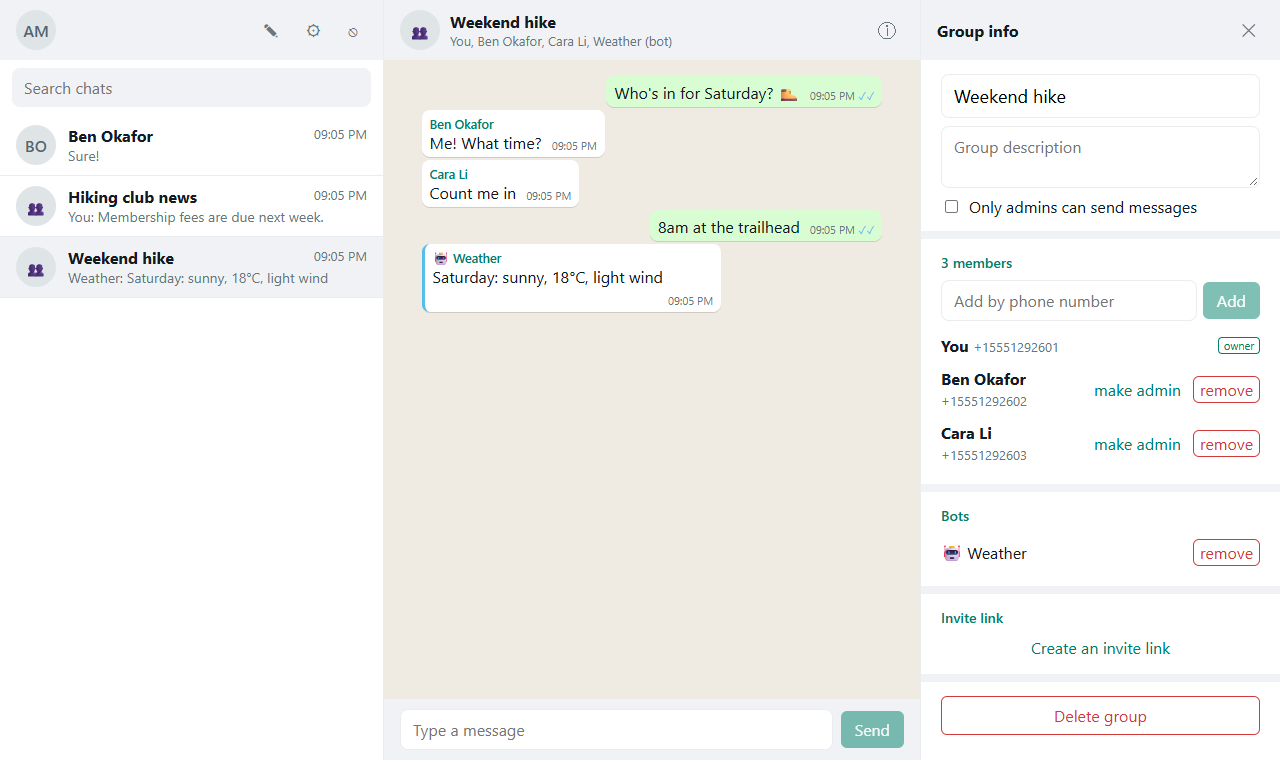
docker compose up -d --build          # the app on http://localhost:8001 (Postgres and rowfence, built from this repository)
./test.sh                             # the API tests: the database in Docker, the tests on the host
For development: docker compose up -d db, then uv run python ../db/migrate.py and uv run uvicorn app.main:app --port 8001 in backend/, and npm run dev in frontend/. While changing the policy, rowfence dev (with MS_ADMIN_URL set; rowfence.toml says the rest) applies it on every save, runs its tests and rewrites the client. The migrations set that database up, so mark it as a development database once first: rowfence push --development.
The rules, and where they are
| What the app does | How the policy says it |
|---|---|
| Only members read a chat | can read = member or bot, and rules ms.messages select : read |
| New members don't see what was said before they joined | message.read = chat.read and {seq > coalesce(ms.joined_seq(chat_id), 0)} (by the message's number: a clock that steps back refuses nothing) |
| Owners and admins manage a group | admin : user = ms.members(chat_id -> user_id) where {role in ('admin', 'owner')}, can manage = admin and {kind = 'group'} |
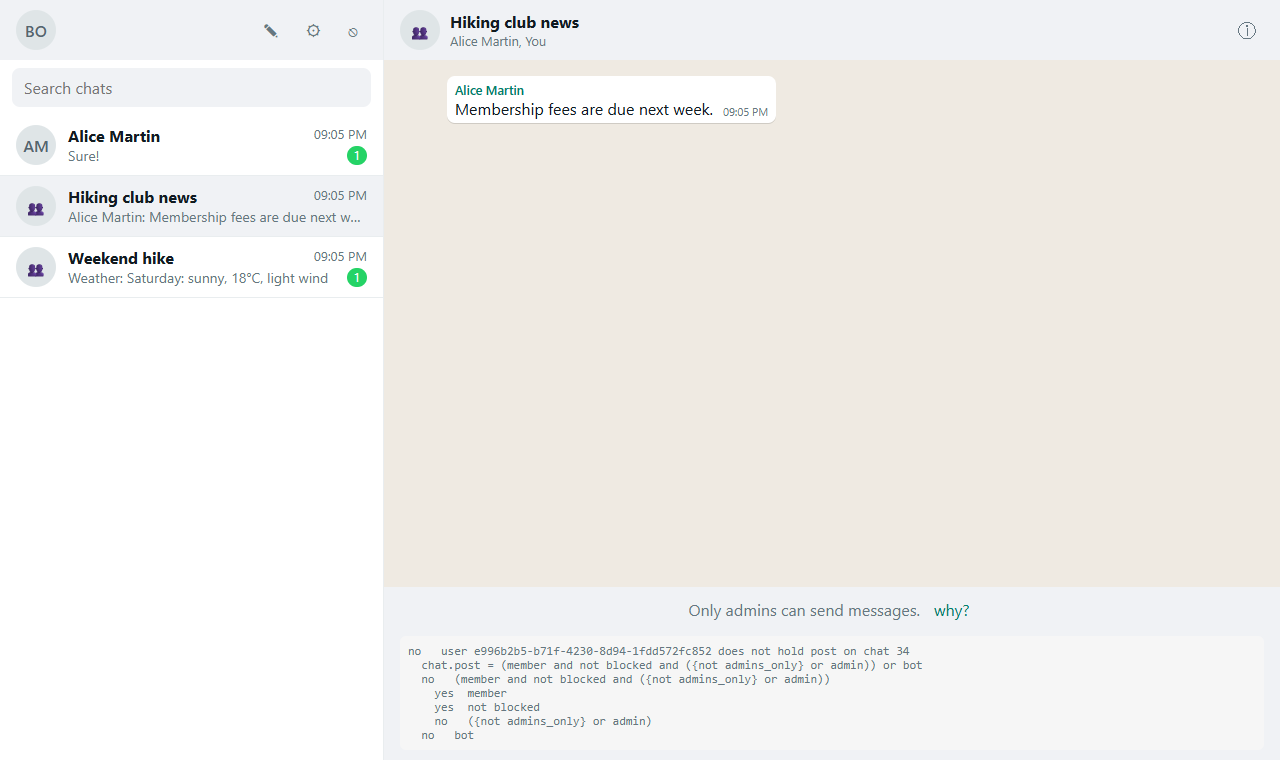
| Announcement groups: only admins post | can post = (member and not blocked and ({not admins_only} or admin)) or bot |
| Blocking: neither can write to the other in their direct chat | blocked : user = ms.direct_blocks(chat_id -> user_id), and not blocked in post |
| ...and someone who blocked you can't be added to a chat with you | rules ms.members insert : ... and not person.has_blocked |
| A direct chat stays two people | add_members = ... or (creator and {kind = 'direct'} and {(select count(*) ...) < 2}) |
| Nobody demotes or removes the owner, nor makes another | update role : chat.manage and {role <> 'owner'}, update role after : {role <> 'owner'} |
| Edit your own messages for 15 minutes | can edit = sender and {not deleted and created_at > now() - interval '15 minutes'} |
| Delete for everyone: yours, or anyone's if you're an admin; no undelete | can remove = sender or chat.manage, update deleted after : {deleted} |
| Invite links anyone can use for a week | invitee : link shared by invite, can join = invitee and {kind = 'group'}; the backend calls authz.create_link |
| Bots post as themselves, only where an admin added them | type bot = ms.bots principal where {active}, bot : bot = ms.chat_bots(...), from_bot in the insert rule |
| Only a bot's owner makes its keys | can manage_keys = owner on the bot type; the backend calls authz.create_api_key(..., 'bot', id) |
| Messages are numbered per chat | type message = ms.messages (chat_id, seq): a composite key; the API asks authz.can('message', '(7,42)', 'edit') |
Each row of this table is a test in db/tests/rules.authz: it makes the people and chats it needs, checks who may do what (as the app, through row-level security), and rolls back. rowfence test runs them: 45 checks, in about a second.
What the backend doesn't have to do
No checks before queries.
POST /api/chats/{id}/messagesis anINSERT. If you may not post there (not a member, blocked, an announcement group), row-level security refuses it, and the API answers 403.No filtering after queries.
GET /api/chatsis a join ofms.chatsand your membership row; it returns only the chats you may read. A chat you're not in answers 404, as if it didn't exist.No "why can't I?" logic. When the database refuses a write, its error says which rule refused it and what is missing. The API passes that on (
refusal(error)from the generated client), and an update that changed nothing asks for the same (authz.expect). The web app shows it behind a "why?" link:no insert : chat.post and ((sender and {bot_id is null}) or (from_bot and {sender_id is null})) (line 95) no chat.post no user 5cf5… does not hold post on chat 16 chat.post = (member and not blocked and ({not admins_only} or admin)) or bot no (member and not blocked and ({not admins_only} or admin)) yes member yes not blocked no ({not admins_only} or admin) no bot yes ((sender and {bot_id is null}) or (from_bot and {sender_id is null}))No permission model in the UI. The chat's
permscome fromauthz.perms, and buttons show or hide by them. The database checks again when you press them.No bot authentication. A bot sends
Authorization: Bearer ak_...; the backend callsauthz.login_key, and the database knows which bot it is (authz.principal()).Live updates that can't leak. A trigger announces "chat N changed" (
NOTIFY ms_events). The backend asks the database once which of the connected people may read chat N (authz.who_among), and only then passes the number on. The browser refetches through the API, which row-level security filters. A WebSocket never carries a message.
What rowfence caught while building it
authz.lint()flagged the blocking view. The viewms.direct_blockswas readable by the app role, and views run with their owner's rights, so they bypass row-level security. The migration now revokes it: only the policy reads it.- Rule conditions run as the app role. "Never add someone who blocked you" first read
ms.blocksin a{condition}. It saw nothing, because a person may only see their own blocks. As a relation (has_blocked, followed withperson.has_blocked), the policy reads it with its own rights. - The plain
updaterule holds before and after the change. "Deleted for everyone" made the message failremoveifremoverequired "not deleted yet". Soremovedoesn't;update deleted after : {deleted}forbids undeleting.
Layout
db/migrations/the tables (plain data integrity),db/policy.authzthe rules,db/migrate.pyapplies both and writes the generated client (backend/app/authz_client.py, fromrowfence client py)backend/FastAPI:main.pythe API,db.pytransactions signed in as a person or a bot,auth.pypasswords and sessions,events.pylive updates,tests/test_api.pyfrontend/React: the chat list, conversations, group info, settings (profile, bots, blocked people)check_public_surface.py: the app uses only rowfence's public functions, never its internals